Reading at Home: How to Help Families with Fall in Love with Books
Written by Fiona McCrudden
You may have seen that the National Literacy Trust’s most recent report into children and young people’s reading habits has shown some green shoots of improvement! More children are enjoying books, and more children are reading daily. This is cause for celebration!
But before we get the cake and party hats out, its important to note that these improvements are small and there is still a long way to go, with levels remaining lower than they were pre-Covid. Perhaps we can treat ourselves to a chocolate biscuit, but the three-tiered celebration cake is still a little way off!
We know schools are doing so many wonderful things to get children to fall in love with books; we’ve seen new reading corners, ‘drop everything and read’ challenges, prizes, reading newsletters and so much more.
So what are the next steps? How can we continue to have impact and maximise this current trajectory of improvement.
Reading at home is an area that still needs lots of support. Families are busy, other priorities take hold, parents don’t feel confident reading, and many can’t afford a bookcase of lovely stories. That last point is really significant and is still an issue affecting reading levels – in fact, the National Literacy Trust report indicates that the gap between Free School Meal (FSM) children and Non-FSM children is widening once more. Children who are on FSM are less likely to read daily than their peers.
What can we do to support reading at home?
We have to make books as accessible and as un-intimidating as possible. We have to help families see it as an every day part of life, not ‘another thing’ to squeeze in to a hectic day like spelling practice and bath time.
Making books accessible
Charity shops are a brilliant place to buy books. I do this regularly whenever I pop into town; the more battered the pages, the more it has been read so I know its going to be a good book!
Similarly, libraries offer fantastic lending services and are always filled with staff who exude enthusiasm for books. If families feel intimidated by visiting a library, known as ‘threshold fear’, try suggesting some of the other services they offer. Many libraries run children’s craft activities, play group style sessions and more that can be a good way in.
Dual language and wordless picture books
Lots of parents don’t feel confident reading out loud and sometimes can labour under the false idea that it only counts if you’re reading all the words and it is in English. This couldn’t be further from the truth. Books in other languages can be tricky to track down in the UK, lots of bookshops don’t stock them, but if you can get them (perhaps a lending library at school could work?) they are a fantastic resource!
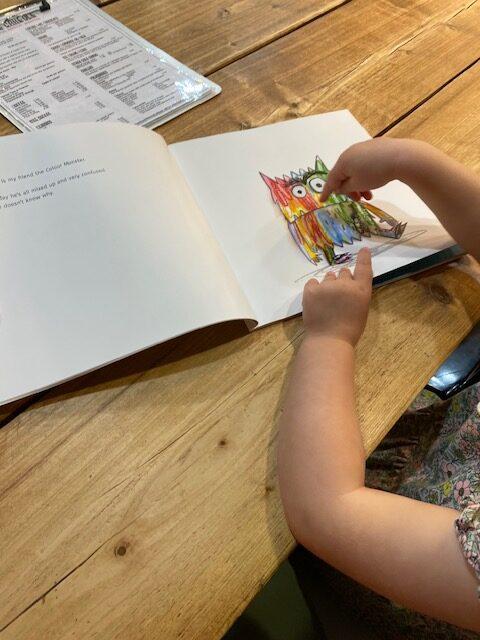
I don’t always read a book ‘properly’ when I read with my children. I might not read every word or if I’m really tired I have, maybe, been known to skip a page or two. Shush, don’t tell them!
There isn’t a right way to read, its just about enjoying the time together and sharing a story. Whatever form that takes. Wordless picture books are wonderful for this too, allowing you to explore the book without the pressure of reading text.
Further support to share with families
Last year, The Story Project worked with Bradford Living Well to produce a video for schools and nurseries to share with families. It is only a few minutes long and gives an easy overview of why reading is important and some top tips for reading at home.
Why not share the link in your next school newsletter?
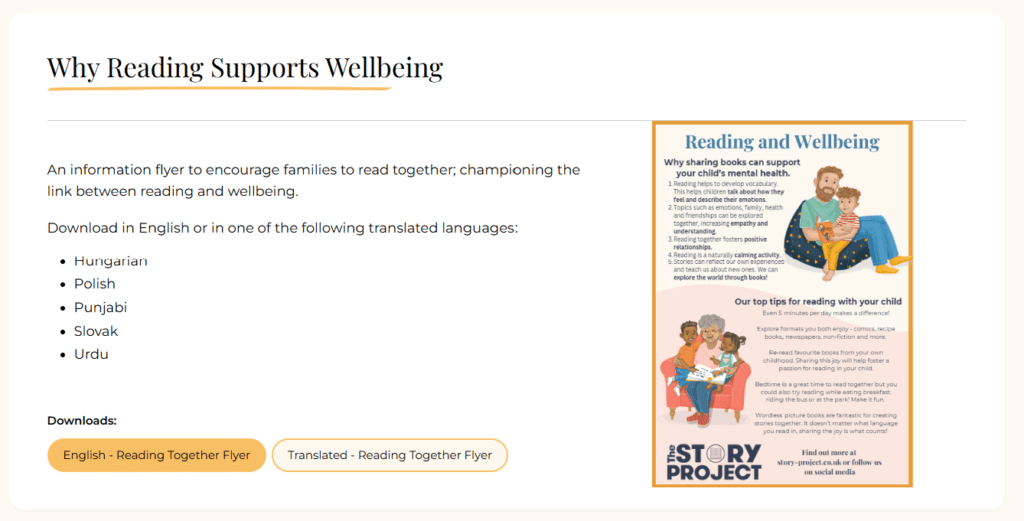
We have also produced a ‘reading at home’ flyer which is translated into a number of common languages in the UK, including:
- Hungarian
- Polish
- Punjabi
- Slovak
- Urdu
You can download the flyers for free. All you have to do is sign up for a free account (bonus points, you also get access to two of our core curriculum units!)
FAQ from parents and families
Why is reading as a child so important?
There is strong evidence to show that children who read more have a greater chance of success later in life. This isn’t just an academic measure, but it also impacts job prospects, communication skills, wellbeing and confidence.
How does reading support children’s wellbeing and mental health?
Reading has a number of benefits on children’s mental health and wellbeing. It supports better confidence because children see their own experiences reflected in stories which is validating and supportive. It also means that children have a wider vocabulary, which supports their ability to express their feelings. Not to mention, books allow children to vicariously ‘walk in another’s shoes’, developing better empathy for their peers and greater understanding of the world.
How often should children read?
The general advice is to aim for at least 10 minutes per day. More is even better, but if parents are only just getting started then we would encourage them to aim for once or twice a week and build up from there.
What is The Story Project?
The Story Project is a social enterprise dedicated to improving reading and wellbeing in schools. We use popular children’s books to explore the PSHE curriculum, using our research-backed resources.